
Programme
The Innsbruck Elementary School (IES), as part of the Accredited European School Tirol, is a public, co-educational primary school. With the beginning of the 2023/24 academic year, it started at the campus of the Saggen primary school.
Our school provides primary education based on the European Schools Curriculum.
At our Saggen campus, we offer the German and English language sections (P1–P4), while the Italian section (P1–P4) is located at the Altwilten campus. Primary year P5 and secondary education (S1–S7) are based at the Angerzellgasse campus. Thereby the Accredited European School Tirol offers a continuous educational pathway from the first year of primary school through to the European Baccalaureate.
In addition to providing a solid academic education, the European School aims to equip its pupils with the skills and attitudes needed to become multilingual, open-minded individuals who are prepared to live and work in an international and culturally diverse environment.
Through a broad and balanced curriculum, our pupils acquire fundamental skills in writing, reading and mathematics, as well as cognitive abilities and social competence. They explore themselves, other people and the world they live in, developing an awareness of their place within Europe.
Compared with the Austrian education system, our school timetable includes the following subjects and teaching hours:
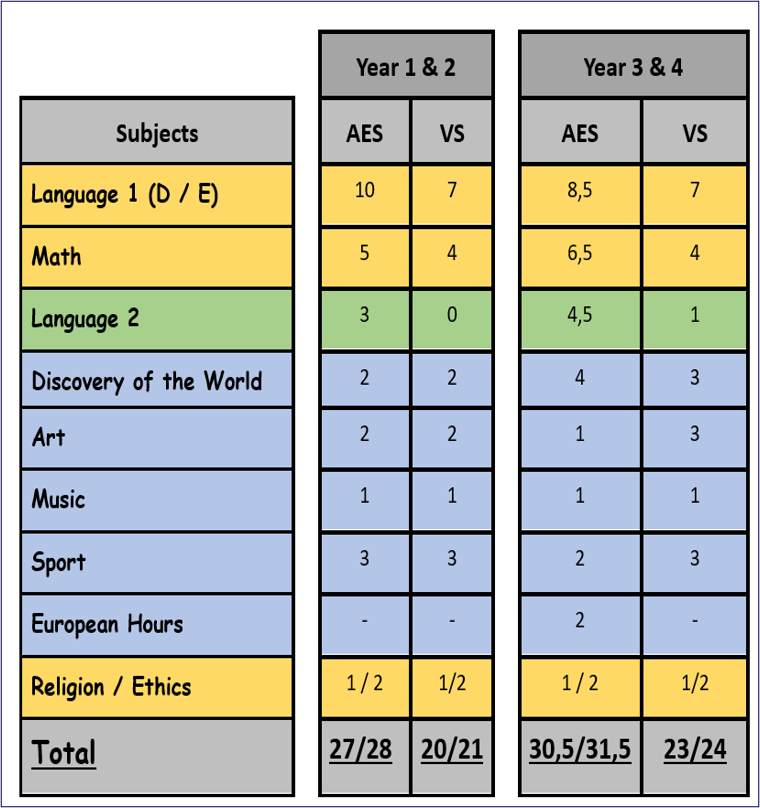
Programme at Innsbruck Elementary School
The European School‘s commitment to education in a child‘s first language is what makes it stand out to other educational systems.
Pupils are assigned to the respective language section according to their first language.
Language L1, Mathematics, Ethics and Religious Education are taught in the language of the respective section.
From the very first year of primary school, pupils receive an increased number of lessons in their second language (L2).
Discovery of the World, Art, Music and Sports are taught bilingually in L1 and L2. These lessons take place in homeroom classes.
In the homerooms, pupils from the German and English language sections learn together in mixed groups. Each group is taught bilingually through team teaching by a native German-speaking teacher and a native English-speaking teacher.
Activities and projects involving our Italian language section are also organised regularly.
The school programme provides for all subjects to be taught by native speaker (D/E) teachers working in teams. The team-teaching approach enables teachers to provide highly differentiated instruction through individualised, practical and pupil-centred learning activities. It also allows them to assess pupils’ progress collaboratively. Furthermore, team teaching provides an essential foundation for bilingual education.
Deutsch Sektion
L1 Deutsch
Mathematik (D)
L2 Englisch
Alle anderen Fächer bilingual D/E
English Section
L1 English
Math (E)
L2 German
all other subjects bilingual E/D
Sezione Italiano
L1 Italiano
Matematica (I)
L2 Tedesco
Bilingue I/D
SWALS
students without a language section
Special Subjects at Our School
The subject Peace Builders provides a practical foundation for children to learn responsibility and respect for others. Its aim is to reduce aggression and negative behaviour at school, at home and in the wider community. At the same time, it seeks to foster a peaceful school environment that supports positive learning and development.
In P3 and P4, the curriculum is extended to include the subject European Hours.
European Hours are an interdisciplinary concept used in the European Schools to promote intercultural learning. Pupils from different language sections are grouped together and rotate between different teachers throughout the school year. As a result, the language of instruction changes as well.
The central aim of these lessons is to foster European ways of thinking, acting and feeling. They cover a variety of areas, including music, creative activities, sports and STEM (Science, Technology, Engineering and Mathematics). The activities and focus areas change every few weeks.
Our Educational Philosophy
We are an enthusiastic, life-long learning community that is committed to supporting students of local and international backgrounds.
High expectations of teachers as well as students ensure a profound high-quality of education. At the same time, we foster self-confidence, self-discipline and self-worth in every student and this enables them to reach their full potential in school and beyond.
Our unique learning environment is characterized by close student, teacher, and family relationships and we understand that communication is an important key to our strong sense of community that is based upon the values of mutual respect, sincere compassion, shared responsibility and continual self-reflection.
The school has a strong focus on new forms of learning and teaching, such as informal education, co-operative and peer learning, cross-curricular teaching and project learning. Our students build a foundation in literacy, numeracy, cognitive and social skills and learn more about themselves, each other and the world through a broad curriculum.
Assessment
Stundents do not receive traditional numerical report cards as used in the Austrian education system.
Assessment is based on the European curriculum and follows a competency-based approach. It describes each child’s learning profile, including learning progress, strengths and areas for development.
Reflecting on individual learning progress and setting personal goals are key elements of the learning process and are documented in a portfolio.
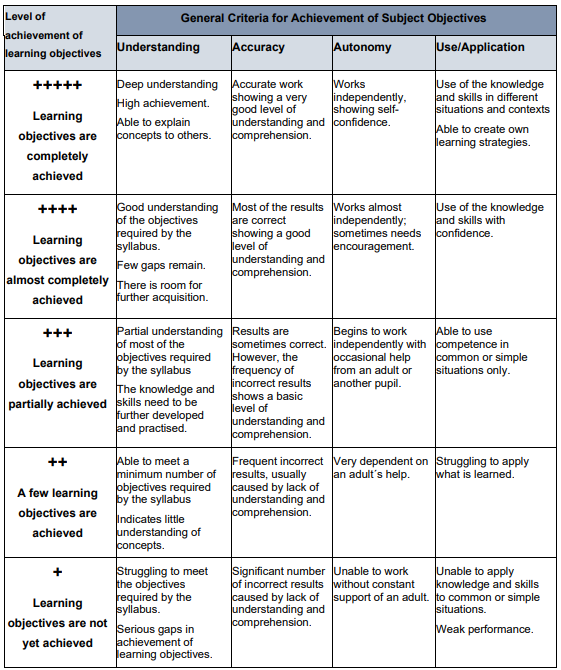
School reports include a competency-based assessment using a five-level scale, complemented by written comments.
The following criteria are taken into account in the assessment: